
Counting money gets easier when children can work through each step. A money workbook for kids can help them practice adding, subtracting, and comparing amounts before they try making change in simple purchase scenarios.
Connecting money skills to everyday choices is helpful, though the steps can feel tricky at first. Coins have different values, and calculating change means comparing an item’s cost with the amount paid. A calm, hands-on activity gives children room to pause, try a method, and learn from each answer.
This article shows how workbook exercises can build these skills in a clear sequence. Explore ways to add and compare coin values, subtract to find change, and make activities feel more like everyday life at home. You’ll also find ideas for choosing an appropriate level of practice and making time for short, supportive sessions together.
Key Takeaways
- Have children group coins, add their values, and compare different combinations to build confidence with amounts.
- Practice making change by subtracting the purchase price from the amount paid, then count the coins back together.
- Choose between workbook pages, apps, and real-life activities based on whether your child benefits most from written practice, interactive prompts, or handling coins.
- Keep home practice short and supportive, using everyday choices to connect money skills with saving, spending, and planning.
Adding, subtracting, and comparing money
A useful worksheet moves from recognizing coin values to combining them. Children might build an amount with a quarter, two dimes, and three pennies, then add each coin’s value to check the total. This makes addition visible instead of leaving it as an abstract calculation.
Look for exercises that show more than one way to make the same amount. A quarter equals five nickels, or two dimes and one nickel. Comparing these combinations helps children understand that different groups of coins can have equal value. Ask them to circle the group worth more, explain how they counted, and check by adding each group separately.
Subtraction practice can use printed prices and coin amounts. Ask your child to identify the starting amount, subtract the cost, and write down what remains. Then have them show the calculation with coins or a number line. If they get stuck, return to the coin groups and remove the amount spent one coin at a time.
Are money workbooks aligned with U.S. financial literacy standards? Alignment depends on a workbook’s learning goals and the standards used by a child’s school or state. Compare the listed skills with your child’s current lessons, such as adding coin values, subtracting amounts, and explaining which group is worth more.
Check that each exercise makes the thinking clear. A strong sequence asks children to count, record, compare, and explain, rather than guess from coin pictures. Notice whether the directions distinguish the number of coins from their total value. For example, five nickels and one quarter involve different coin counts but equal value. Choose practice that lets children show their method, correct a mistaken count, and try the same skill with a new combination. This helps adults see whether a child understands the value relationship or has only memorized an answer.
Making change
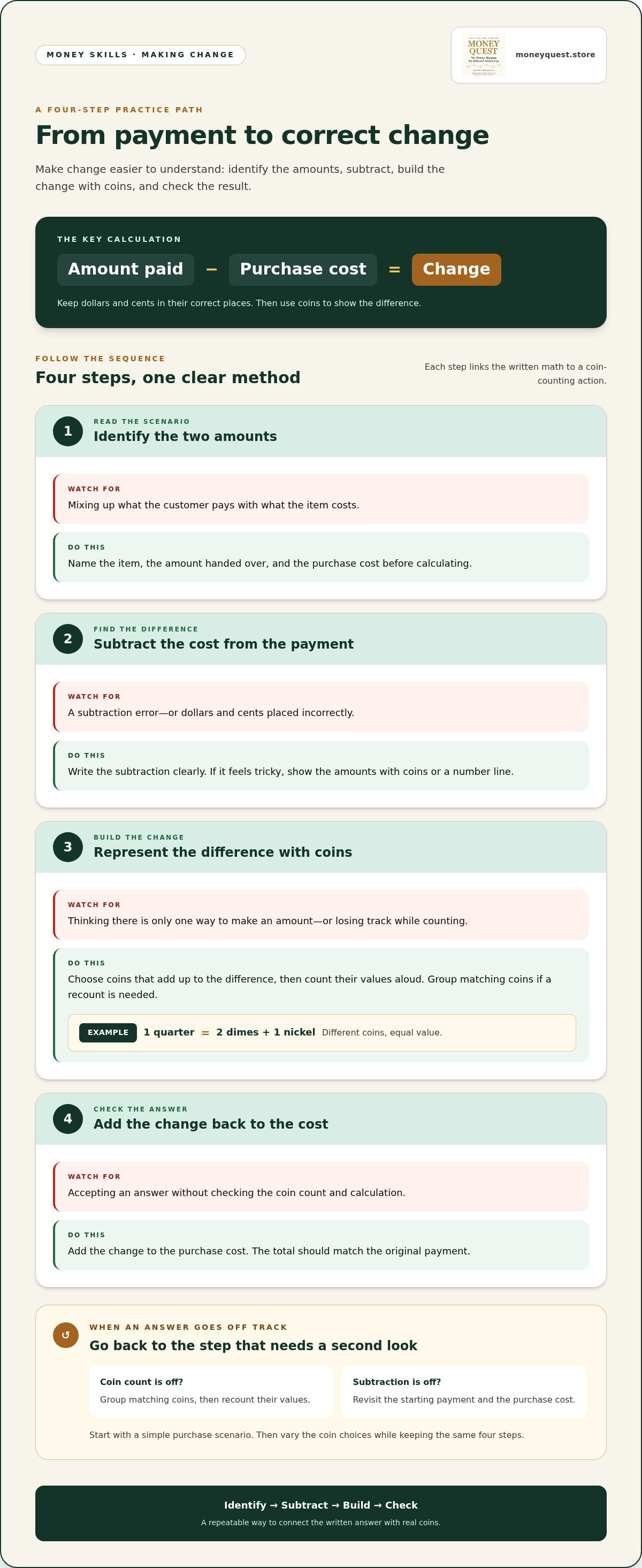
Making change combines subtraction with counting coins. A child first finds the difference between the amount paid and the item’s cost, then checks whether coins can represent that difference. A money workbook for kids should show both steps so children learn the calculation and how it applies to real currency.
Choose exercises with clear purchase scenarios and room to show the math. For each one, invite your child to identify the amount paid, the cost, and the change. They can subtract the cost from the payment, then count coins to confirm the result. If they get stuck, use play coins or draw coin symbols beside the calculation.
- Read the scenario. Identify what the customer buys and how much they hand over.
- Find the difference. Subtract the cost from the amount paid, keeping dollars and cents in their correct places.
- Build the change. Choose coins that add up to the difference, then count their values aloud.
- Check the answer. Add the change back to the purchase cost. The total should match the original payment.
Look for practice that allows different coin combinations. For example, a quarter can be returned as two dimes and one nickel. Ask your child to show that combination, then count its value. This connects the written answer to the coins a cashier might hand back.
Good practice also makes mistakes easier to spot. If a child counts the coins incorrectly, ask them to group matching coins before recounting. If the subtraction is off, revisit the starting payment and purchase cost. Keep the scenario simple at first, then vary the coin choices while keeping the same steps. For extra structured activities, explore guided money practice that can support learning at home.
How do money workbooks compare with apps and hands-on activities?
A workbook, an app, and a pretend shop can teach the same money concept in different ways. A workbook gives children space to write calculations, draw choices, and revisit earlier answers. An app can offer digital questions and visual prompts, while a hands-on activity lets children handle play coins or sort household receipts. Choose the format that best supports the skill your child is practicing.
Written pages support careful, step-by-step thinking. For example, a child can label a worksheet “needs” and “wants,” then explain where a pretend purchase belongs. They can also show how they reached an answer instead of selecting one on a screen. Look for clear instructions and enough room to write, especially when an exercise asks for a reason or comparison.
Apps can make practice interactive. Before using one, review a sample activity together. Notice whether your child needs to read a prompt, make a choice, and understand the response. Use the screen as a starting point, then ask them to explain their decision aloud. That conversation connects tapping an answer with the thinking behind it.
Hands-on activities bring money choices into a familiar setting. Set up a pretend store with household objects, price labels, and play money. Let your child take turns being the shopper and cashier. They can select an item, count out payment, and talk through the choice. A household sorting task works too: group sample receipts by type, then discuss which purchases might be planned in advance.
Try one format at a time before combining them. Your child might complete a workbook prompt, then act out a similar choice in the pretend store. Use an app for a short review afterward. Keep the learning goal consistent across activities, such as explaining a spending choice or making a simple plan. This makes it easier to see which format holds your child’s attention and where another example could help.
How can parents use a money workbook with kids at home?
Choose a workbook activity and connect it to a familiar family decision. Before starting, ask your child what the page is teaching, such as planning spending or comparing choices. Work through the first example together, then let them try the next one. A pencil, scrap paper, and a quiet spot are enough to begin.
Use a family budget exercise to discuss how spending fits into different categories. According to Peace Corps, one activity asks learners to calculate how much a family can spend in each category in a normal year. Talk through the choices together and invite your child to explain which category each amount belongs to. Focus on the reasoning, not on judging family decisions.
A grades 6-8 activity offers another role-play idea: participants can pretend their gross wages are $500 or choose another amount. Use that prompt to discuss how a person might plan before spending. Ask your child what they would consider first, then have them record a simple plan in the workbook. The scenario creates a starting point for discussing priorities without turning the conversation into a real family budget disclosure.
- Set a small goal. Choose one page about saving, spending, or planning.
- Read the directions. Point out the decision the activity asks your child to make.
- Let them try. Give your child time to write an answer before discussing it.
- Talk it through. Ask what guided their choice and what they might change.
Keep each session focused on the workbook’s specific task. If a child is unsure, reread the prompt and work through one part together. For more structured practice at home, explore guided family money activities that connect saving, spending, and planning.
Moneyquest: Raise Money-Smart Kids PDF
Raise Money-Smart Kids PDF gives families a structured way to practice saving, spending, budgeting basics, and financial decisions at home. Designed for children ages 10-12, it offers six money missions with activities intended to take about 15-20 minutes each.
The 44-page workbook supports short, focused sessions. A family can work through one activity, discuss the choices, and continue when ready. Its money missions give parents a guided starting point for conversations about everyday decisions, while children practice thinking through their own answers. The workbook is shown in color and black-and-white editions.
For a ready-made resource to explore money skills together, visit moneyquest.store to learn about the Raise Money-Smart Kids PDF workbook.
Make money practice part of everyday choices
A useful next step is to connect learning with decisions your child already makes. Before a small purchase, invite them to consider what they want, what they need, and how they might plan for it. Later, talk about what they chose and whether they would make the same decision again. These calm conversations help money skills feel relevant beyond a worksheet.
Use a money workbook for kids as a starting point, then let your child explain their approach. There isn’t one perfect way to begin. A shared activity can open the door to questions and give your family a simple routine for discussing choices. Follow your child’s curiosity and let the next conversation grow from there.
Explore workbook activities and choose a starting point for practicing together. Small, thoughtful conversations can help your child build confidence one decision at a time.
Frequently Asked Questions
What topics should a children's money workbook cover?
A well-rounded workbook can cover saving, spending choices, budgeting, and decision-making. Look for activities that ask children to set a goal, sort needs from wants, or explain why they chose one option over another. For example, a child might plan to save toward a desired item while leaving room for everyday needs. Prompts that invite discussion connect written exercises with family conversations.
What are the best money workbooks for preschool and elementary-age children?
The best fit depends on what a child can comfortably understand and do. Preschoolers may benefit from picture-based matching, sorting, and pretend-play prompts. Elementary-age children can work with written scenarios, simple spending plans, and explanations of their choices. Review the directions and examples before starting. A suitable workbook lets a child make progress without needing an adult to explain every instruction.
Are money workbooks for kids available as printable PDFs or free downloads?
Money-learning activities are available as printable PDFs, though free access depends on the publisher. Before choosing a download, see whether it includes complete activities or only sample pages. Check whether the file is designed for printing and whether its use is limited to one learner or supports group activities. These details help you select a format for home or classroom practice.
What skills should kids learn about U.S. coins, bills, and making change?
Children can learn to identify coin and bill denominations, read their printed values, and combine amounts accurately. They should understand that a coin’s appearance alone doesn’t determine its value. For change practice, have them compare the purchase cost with the payment, then explain how they would check the amount returned. A written receipt or pretend price tag gives the exercise a clear, everyday context.