Mission 01 · Pages 7–11
Your Money, Your Plan
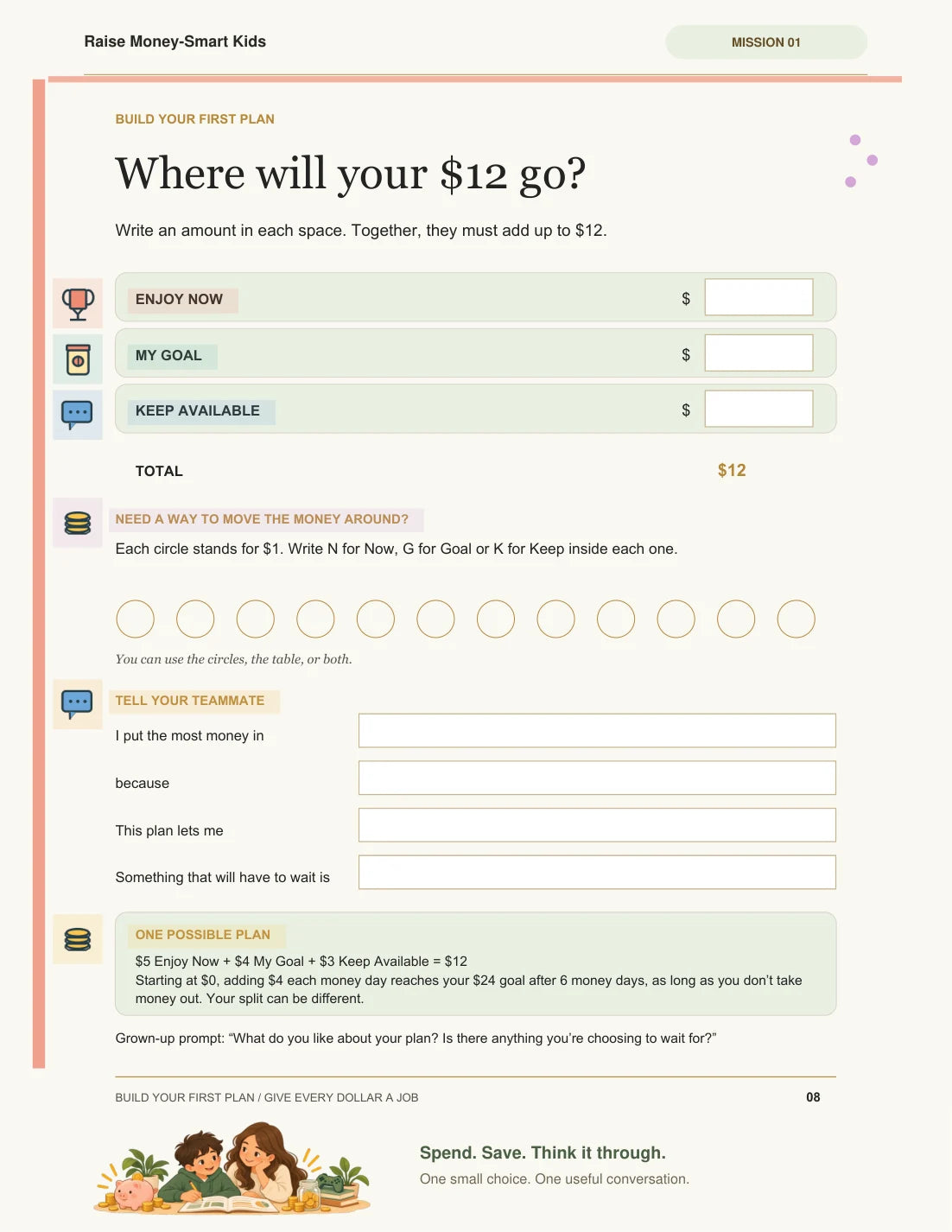
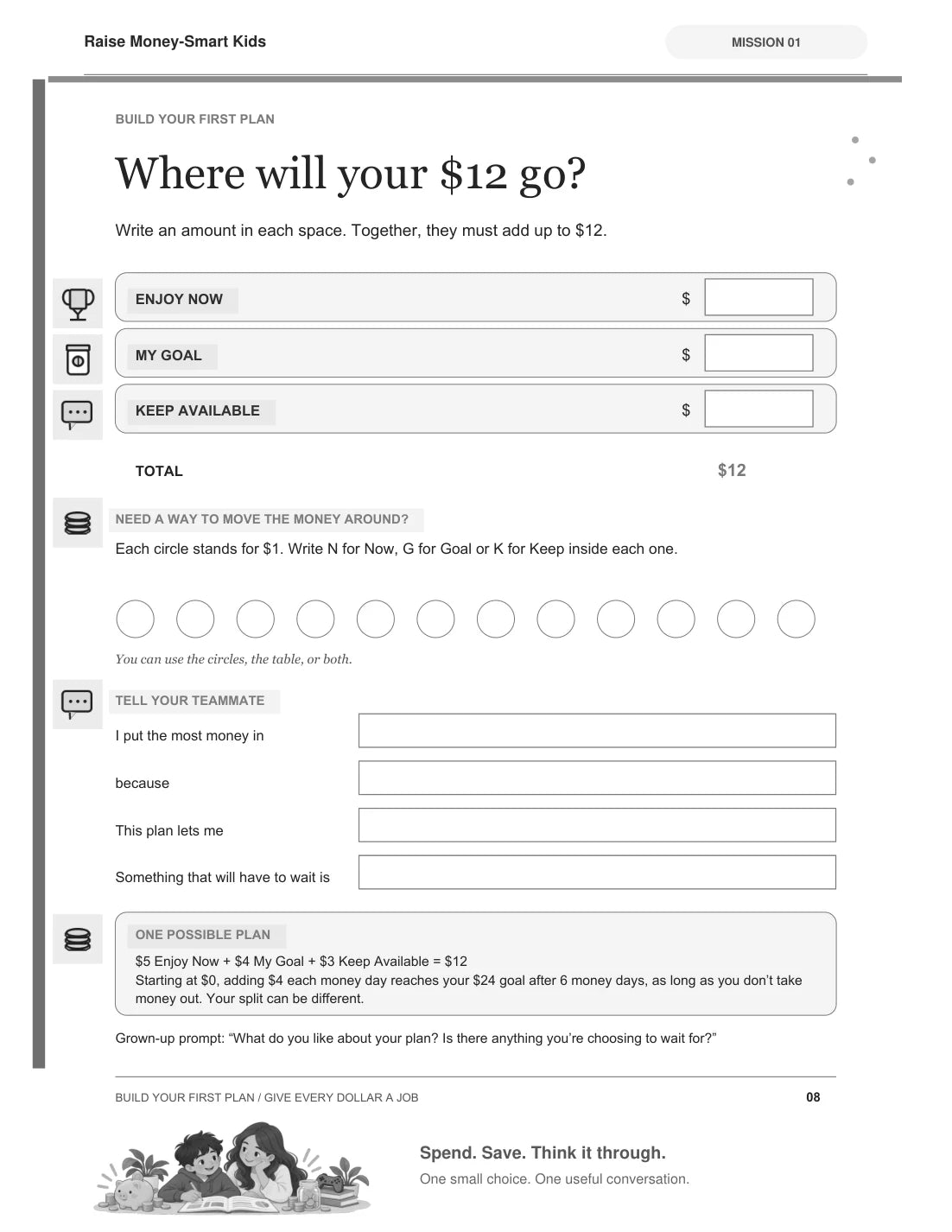
Help your child decide how much money to spend now, save for a goal, and keep for later.
For children ages 10–12 and their parents
Help your child learn to save, spend, and plan a budget. This PDF workbook includes 6 simple activities you can do together.


Raise Money-Smart Kids · A PDF workbook for parents and children.
Taxes included. PDF download. No printed book.
Digital PDF download · One-time payment
No printed book will be shipped
A 44-page workbook in English. Choose the full-color version, the black-and-white version, or the Complete Bundle with both. The activities are the same in each version.
Includes instructions, 6 money activities, and worksheets you can use again. Made for parents and children ages 10–12. Most activities take about 15–20 minutes.
Small choices. Meaningful conversations.
Reflections on saving, spending and learning together.
My son actually thinks twice before spending his money now. That's a big change for us.
My daughter finally understands the difference between wanting something and actually needing to buy it.
Instead of asking me to buy everything she sees, my daughter has started saving for things she really wants.
My kid used to spend every dollar as soon as he got it. Now he actually has a plan for his money.
The biggest change I've noticed is that my son can explain WHY he wants to buy something instead of just asking for it.
My daughter started checking how much money she'd have left before deciding what to buy. I never had to remind her.
My son is starting to understand that spending money on one thing means giving up something else.
I love seeing my daughter make her own money decisions instead of expecting me to make every choice for her.
I was surprised by how practical this was. It's not just another PDF full of financial tips.
The activities are simple enough for kids to understand but thoughtful enough to lead to real conversations.
I love that each mission only takes about 15–20 minutes. We can easily fit one into our weekend.
Everything is laid out clearly. I didn't have to spend hours figuring out how to teach my child about money.
The scenarios feel surprisingly realistic, especially the ones about video game purchases and peer pressure.
What makes this different is that kids actually get to make decisions and see the consequences.
I appreciate that there's no pressure to get every answer right. It's about helping kids think through their choices.
The reusable worksheets are a huge plus. We can come back to them whenever a new money situation comes up.
Money used to be something I lectured my kids about. Now it's something we actually talk about together.
For the first time, talking about money with my son didn't turn into an argument.
I honestly didn't expect a money activity to become something my daughter and I enjoyed doing together.
I love that this teaches my child to think independently without making me feel like I'm losing control over spending rules.
Instead of constantly saying no, I can ask my son to think about his budget and explain his choice.
It's helped us have better conversations about spending without making my child feel guilty for wanting things.
My favorite part was hearing my daughter explain her decisions. It showed me how much she's starting to understand.
The game-shop mission was an eye-opener. My son finally saw how those little in-game purchases can add up.
The 'Everyone Has It' mission was exactly what my daughter needed. She's learning that she doesn't have to buy something just because her friends have it.
The saving goal activity made the idea of saving feel much more achievable for my child.
My son loved planning a family activity with his own budget. He took it so seriously!
The surprise weekend challenge was a great way to teach my daughter that plans can change without everything falling apart.
The before-you-buy checklist is something I can genuinely see us using again and again.
For $29, I got six activities we can work through together and worksheets we'll actually use again.
I've bought educational printables before, but this one feels much more focused on real-life decisions.
It's refreshing to find something that teaches financial responsibility without making money feel scary or complicated.
I wish I'd learned some of these money habits when I was my kid's age.
This gave me a practical way to teach something I knew was important but didn't know how to explain.
It's one of those purchases that feels useful beyond the first time you open it.
My kid is finally thinking before spending.
Less arguing about money. More actual conversations.
Financial education that doesn't feel like homework.
My daughter finally has a reason to save.
Six missions. So many useful conversations.
My son actually enjoyed learning about money.
Finally, a way to teach money skills without lecturing.
The first money activity my child actually wanted to finish.
Simple activities. Real-world money decisions.
It helped my child understand that every purchase is a choice.
Talk about money with your child.
Your child may want to buy something in a game, get what a friend has, or spend money on a weekend activity.
This workbook helps your child compare prices, make a simple budget, and decide what to buy or save for.
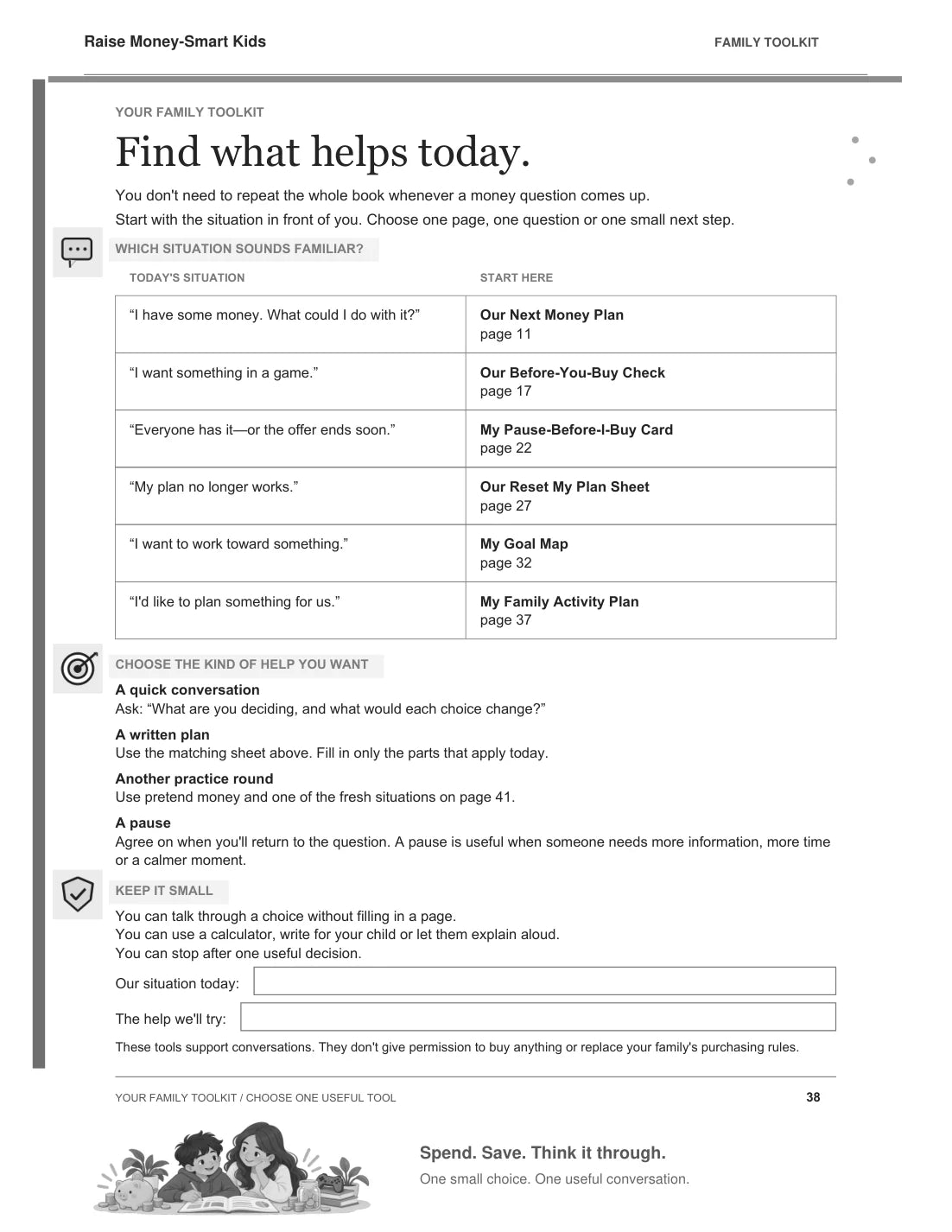
You can help your child with the math and talk about each choice.
What your child will learn
Learn to save, spend, and make a budget
using examples children understand.
Mission 01 · Pages 7–11
Help your child decide how much money to spend now, save for a goal, and keep for later.
Mission 02 · Pages 12–17
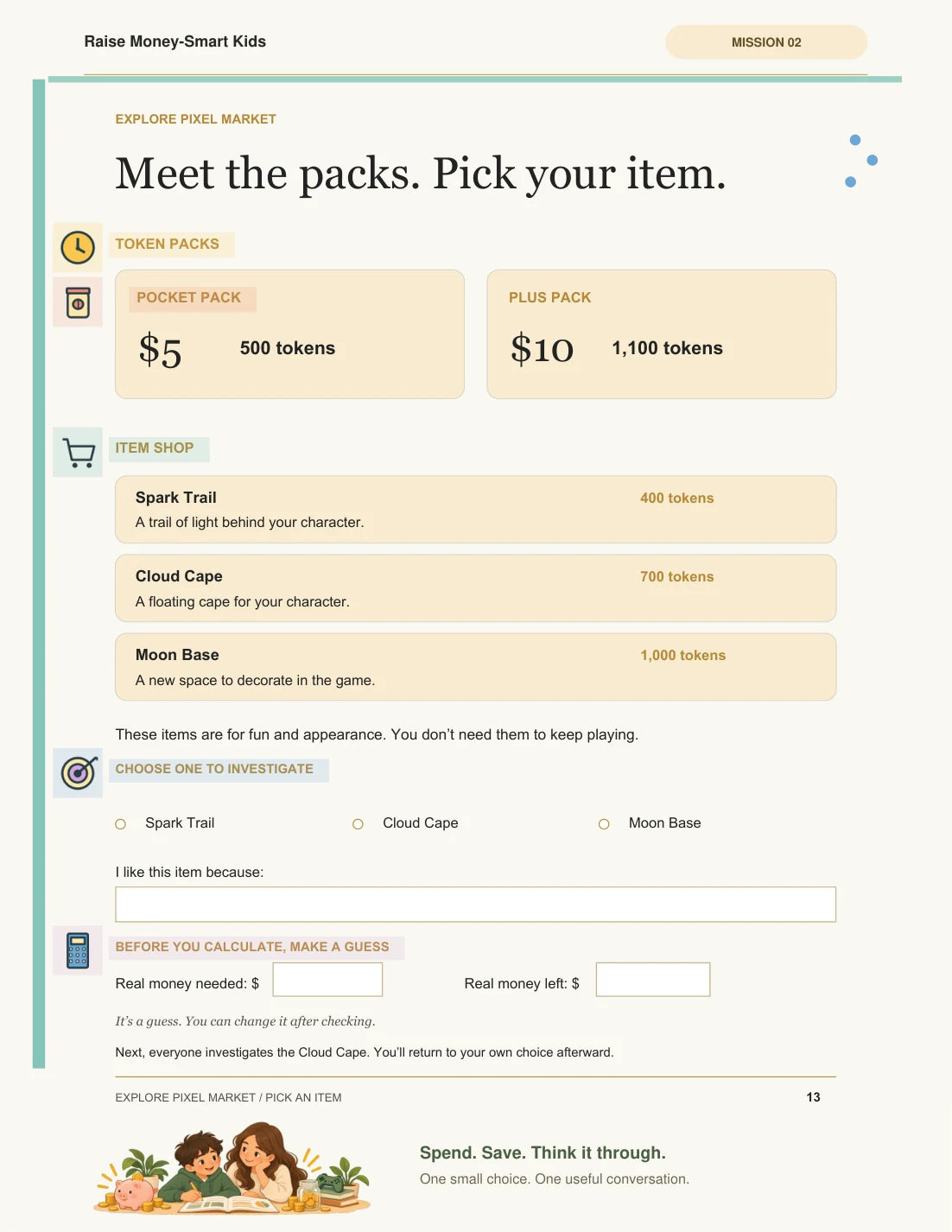
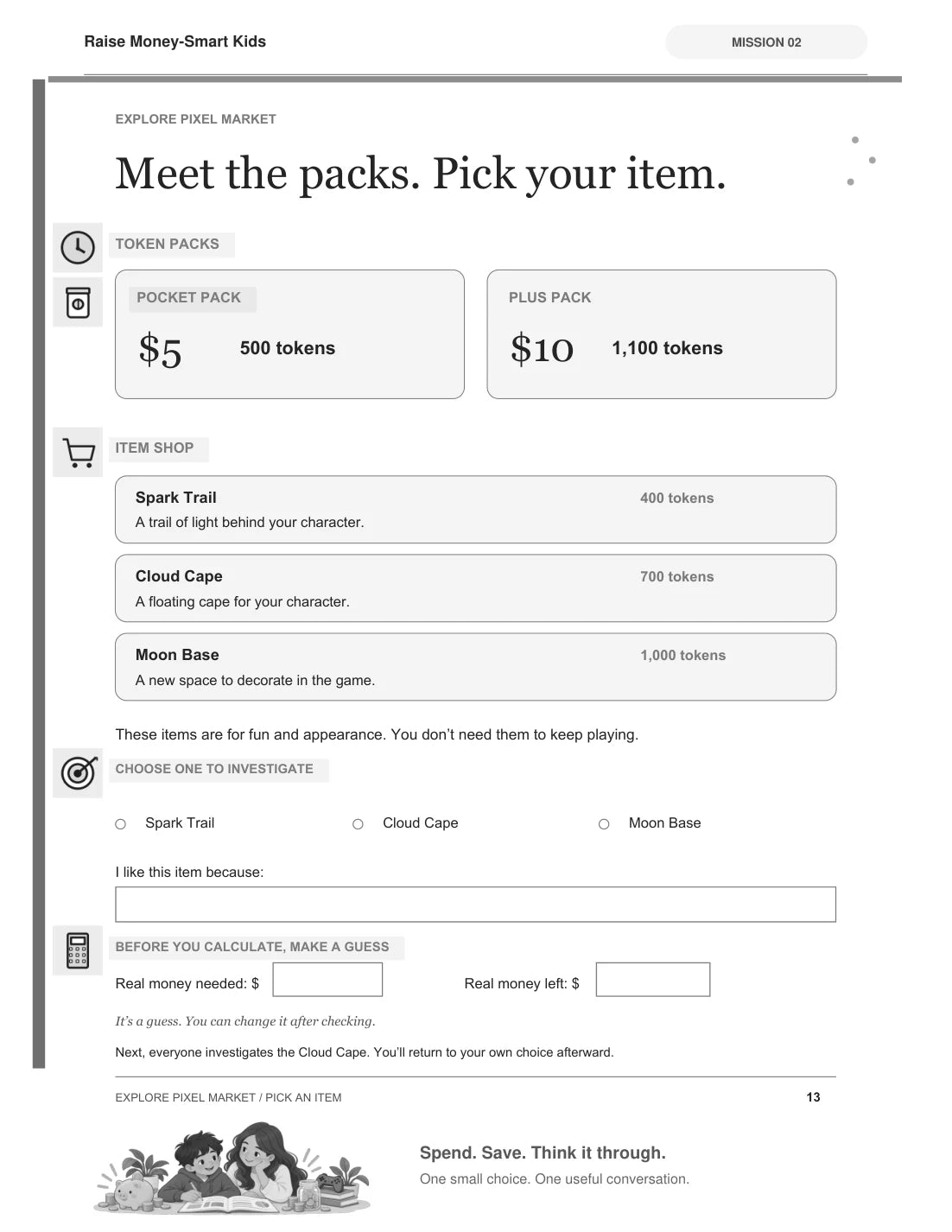
Calculate how much in-game items cost in real money.
Mission 03 · Pages 18–22
Talk about buying something because friends have it, and whether your child really wants it.
Mission 04 · Pages 23–27
Change a budget when plans change or something costs more than expected.
Mission 05 · Pages 28–32
Pick something to save for and make a plan to save enough money.
Mission 06 · Pages 33–37
Help your child plan an activity using a budget you choose.
REAL PAGES FROM BOTH PDF VERSIONS
These are pages from the new Color and Black & White PDFs.
Select any page to view it at full size.
Both versions have the same 44 pages and activities. Only the colors are different.
Easy to use at home
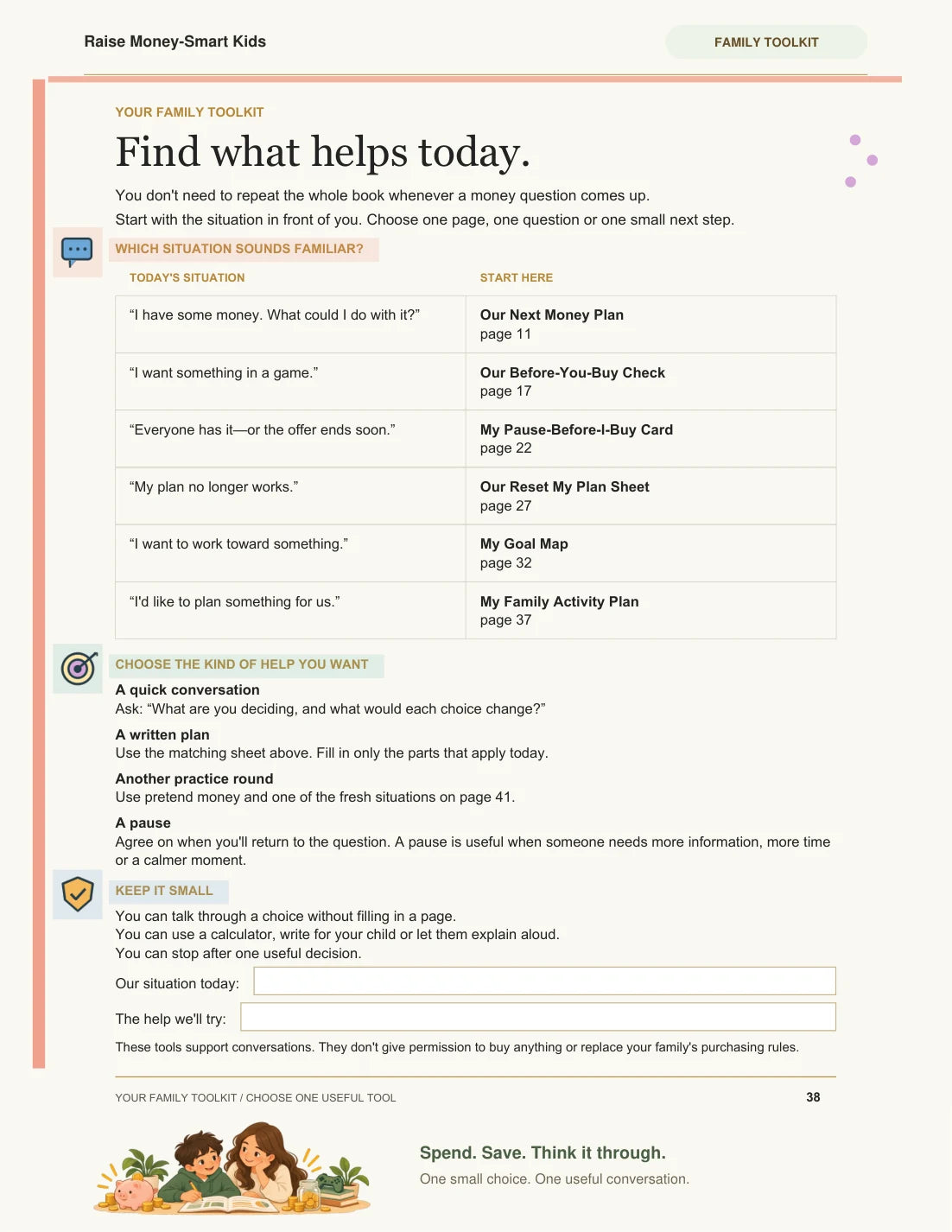
Open the PDF or print the pages you need. Read an activity with your child. Help with the math and talk about the choices together.
See the WorkbookPick an activity your child is interested in. Plan for about 15–20 minutes.
Use the example budget. Talk about what each choice costs and why your child chose it.
Use the worksheets again when your child wants to plan a new purchase.
Common questions
Raise Money-Smart Kids helps parents teach children ages 10–12 about saving, spending and budgeting at home. You can complete the activities together, help with the math, and talk about money choices.
You receive a 44-page PDF workbook in English. Choose Color, Black & White, or the Complete Bundle (both versions). Every version contains the same activities. It also includes instructions and worksheets you can use again. No printed book will be sent.
After you buy, you will receive a download link for the PDF file or files in your selected version. Save a copy so you can use the activities again.
You can print the pages. You can also type into fillable PDF fields using a compatible PDF reader. Some PDF apps may not support these fields, so test saving your answers first.
Most activities take about 15–20 minutes. You can stop and come back later. You can start with any activity.
No. The workbook includes example budgets. Your child does not need to spend real money. Parents choose what their child can buy.
It is a PDF workbook with examples, math questions, and activities to discuss together. It is not an online game or a live class. There is no subscription.
No. Every child learns at a different pace. The workbook gives you activities to practice money skills together. It is an independent learning resource and is not endorsed by the organizations listed in its sources.
Learn about money together.
Get the PDF workbook, choose an activity, and practice money skills with your child.
See the Workbook